

Well Water Treatment: Is Well Water Safe to Drink?
Only a laboratory test can tell you whether well water is safe to drink, and even the same well can change with the seasons. The right order is: test first, then treatment that matches the results. A reverse osmosis system greatly reduces limescale, nitrate and dissolved salts; bacteria, however, need separate measures.
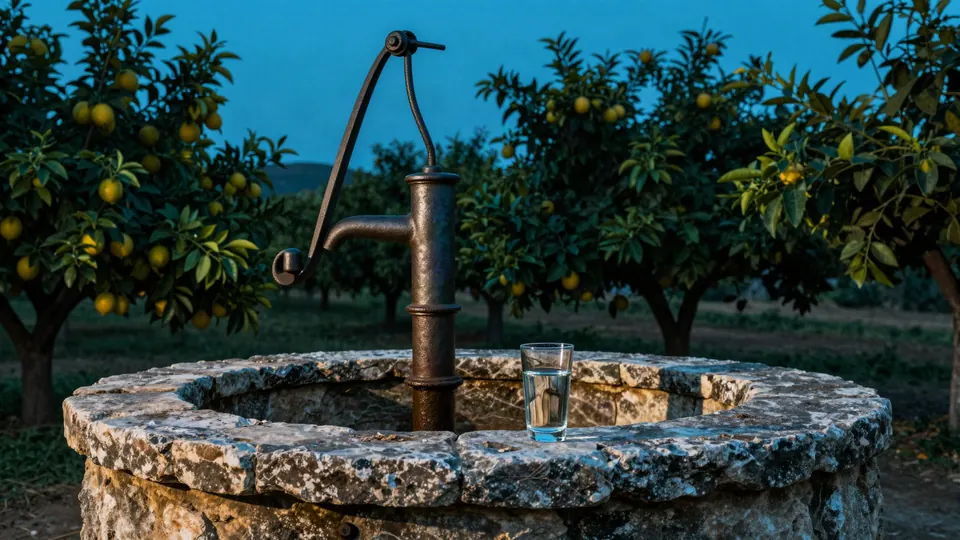
The most common problems with well water
Mains water is regularly disinfected and monitored; with well water, that responsibility lies with the well's owner. The problems most often found in well water are:
- Bacteria: Coliform bacteria can occur in wells close to septic tanks or animal shelters, or whose tops are not properly sealed. You cannot tell from its taste or appearance that water contains bacteria.
- Nitrate: In wells near farmland, nitrate from fertiliser and animal waste can rise.
- Limescale: In Antalya, where the ground is mostly limestone, groundwater is usually hard. More details in our article Why is Antalya's water so hard?
- Iron and manganese: These give water a metallic taste and a reddish or blackish colour, and stain sinks.
- Sediment and cloudiness: Sand and mud can get into the water, especially after rain.
- Odour: A rotten-egg smell comes from hydrogen sulphide in the water.
Test first: where, and how often?
Before drinking well water, have it tested for microbiological and chemical parameters at an accredited laboratory. In Antalya, the Water Quality Control Laboratory of ASAT, Antalya's water utility, tests well water for a fee, and private accredited laboratories offer the same service. The laboratory will give you a sterile sample container and explain how to take the sample; a sample taken incorrectly spoils the result.
The US Environmental Protection Agency (EPA) recommends testing private wells at least once a year for coliform bacteria, nitrate, TDS and pH. You should also test again after a flood, after any repair to the well, or if the taste, colour or smell of the water changes.
On a home visit we measure the TDS of your water free of charge. TDS shows the amount of dissolved salts and minerals in the water; it tells you nothing about bacteria or many chemicals. That is why it is no substitute for a laboratory test. More details in our article What is TDS?
Which treatment for which test result?
| Problem | Suitable solution |
|---|---|
| Sediment, cloudiness | Sediment pre-filter; if needed, a separate sand filter at the well outlet |
| Limescale (hardness) | A reverse osmosis system for drinking and cooking water; a softening system for the whole house |
| Nitrate | Reverse osmosis greatly reduces nitrate; regular testing is essential |
| Bacteria | Disinfecting the well and finding the source; a UV steriliser for ongoing protection |
| Iron, manganese | Pre-treatment suited to these substances before reverse osmosis; otherwise the filters clog quickly |
| Sulphur smell | Carbon filter or pre-treatment by oxidation |
The table is a general road map; the right solution depends on the values in your test results. If there is more than one problem, the order matters: sediment and iron are removed first, then comes reverse osmosis, and if there is a risk of bacteria, UV comes last.
How does a reverse osmosis system work with well water?
A reverse osmosis system works on the same principle with well water: the membrane holds back most of the dissolved salts, limescale and nitrate. There are two differences. Because well water usually carries more sediment, the pre-filters fill up faster than with mains water and may need replacing more often. And the pressure of water from a well depends on the well pump and the pressure booster set; if the pressure is low, a system with a pump is needed. We explain what the membrane does and does not remove in our article What is a membrane filter?
An important warning: home reverse osmosis systems are not disinfection systems designed for microbiological safety. Do not drink water from a well that has tested positive for bacteria relying only on a water filter; the well must first be disinfected and the source of contamination found.
Is boiling enough?
Boiling kills bacteria but does not remove nitrate, limescale or other dissolved substances. In fact, as the water evaporates, nitrate and salts become more concentrated in the water that is left. That is why boiling cannot make water from a well with high nitrate safe to drink.
Well water in Aksu, Döşemealtı and Serik
In Antalya's central districts, most homes use mains water. In districts with many houses with gardens and a lot of farmland, such as Aksu, Döşemealtı and Serik, we often come across addresses that use well water or water from a storage tank. At these addresses we measure TDS on the home visit and, if you have a laboratory result, recommend a system based on it. If you have no result, we ask you to have the water tested first.
Sources
Questions about well water
Is well water safe to drink?
Only if a laboratory test shows that it is. Because the quality of well water can change with the seasons and with influences from the surrounding area, the test should be repeated every year.
Is well water safe to drink once boiled?
Boiling kills bacteria but does not remove nitrate or limescale; nitrate becomes more concentrated in boiled water. You cannot make water with high nitrate safe to drink by boiling it.
Where can I have well water tested?
In Antalya, ASAT's Water Quality Control Laboratory tests well water for a fee, and private accredited laboratories offer the same service.
Does a reverse osmosis system remove bacteria from well water?
Home reverse osmosis systems are not disinfection systems. If a well tests positive for bacteria, the well must first be disinfected; a UV steriliser is used for ongoing protection.
More guides
- Why Is Antalya's Water So Hard?Where the city's water comes from, measured hardness levels, whether it is safe to drink and ways to deal with limescale.
- What Is a Membrane Filter and When Should It Be Replaced?How does a reverse osmosis membrane work, what does it remove, why does it wear out and how can you tell it is time to replace it?
- Can You Drink Tap Water in Antalya?Who checks the mains water, what changes its taste, and how can you get it tested?
The right solution for your well water
Send us your test results on WhatsApp and we will work out the right treatment for your water together. The home visit and TDS measurement are free.